

The Lovefeast was introduced into Britain by John Wesley as a way of bringing together Methodist members in an informal way. Food was prepared and shared among the faithful whilst they declared their love and wonder of God. Admission to the smaller lovefeast services was by ticket, with a steward placed on the door to ensure tickets were up to date.
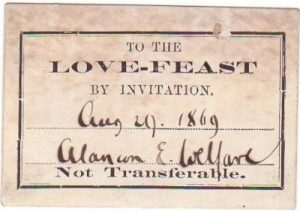
The First Lovefeast
The first Lovefeast witnessed in the West Riding of Yorkshire was on Sunday, July 19, 1761, at Birstall. John Wesley, who presided, later wrote:
‘Many were surprised when I told them the very design of a lovefeast is a free and familiar conversation, in which every man, yea and woman, has liberty to speak whatever may be to the glory of God. Several then did speak, and not in vain.’
‘The flame ran from heart to heart; especially while one was declaring with all simplicity, the manner wherein God, during the morning sermon (on those words, ‘I will, be thou clean’) had set her soul at full liberty. Two men spoke to the same effect; and two others, who had found peace with God. We joyfully poured out our souls before God, and praised him for his marvellous works.’ (quoted in Stamp, 1840)
Popular
Lovefeasts proved very popular, often drawing large numbers. Laycock, in his book, Methodist Heroes of the Great Haworth Round, quotes one held shortly after Wesley’s death in a field at Yeadon that attracted 10,000 people. Lovefeast services usually began with a hymn followed by prayers. After grace was said a lovefeast cake was shared, along with water, drunk from a two-handled cup. This was followed by personal testimonies, and some would read from the scripture or recite from memory a verse or a hymn. In early Methodism the lovefeast often started at 8.00 am, typically lasting around two hours. (Dawson, 1978). (See also the recipes for Lovefeast Loaf )
Not Always So Godly
Later Lovefeasts in the region were not always so Godly as those envisaged by Wesley. In 1871 there was a love-feast arranged for Silsden, West Yorkshire. An account of this reported that:
‘ … 16 stones of flour to be baked into buns of 6 oz each (with currants in) for the Sunday; that delegates be presented with a ticket each for the tea-party on the Monday; that 2,200 snaps be provided for the love feast. ‘
But it was afterwards reported that:
‘The crowds of people that attended were so great that not only were all the special provisions prepared for them insufficient, but the supplies of the places of refreshments and private homes were also exhausted. On the Sunday evening, by some misunderstanding, the doors of the chapel were kept closed until a few minutes before the Lovefeast was due to commence. The space in front of the chapel was filled with people and when the doors were opened there was an ugly rush, in the course of which the glass in the swing doors was broken.’
(With thanks to Cathy Liddle, local historian, Silsden, for this account).
Sources:
Stamp. W.W. (1840) Historical Notices of Wesleyan Methodism in Bradford and its Vicinity. Published by Henry Wardman, Bradford.
Dawson, J.M. (1978) Methodism at the Grass-Roots in the Great Haworth Round. Wesley Historical Society, Yorkshire Branch, Occasional Paper no.3.


