


Green Balsam apples, once widely grown across Yorkshire
Yorkshire is not a region generally associated with apple growing. But there are a surprising number of apple varieties with their ancestry from within the region. Some varieties can be traced back to the early part of the 18th century and in the 19th century, and many country cottages and larger houses had their own fruit trees. Even in and around Yorkshire cities there were orchards to be found in the larger gardens, including at Sheffield, Leeds, and York, and this encouraged the cultivation of new varieties.
Not that you will find any of these apples now in your local supermarkets, where your choice will be very limited to a handful of varieties. But search in the markets of small Yorkshire towns and you can still find them. Or better still, if you have the space, grow your own and keep the heritage alive.
Origins
Apples came originally from the mountains between China and Kazakhstan. Merchants carried the fruit along the Silk Route to the Balkans, and beyond. The Romans planted orchards in Britain and grafted their own favourites onto seedling apples here. Traders to Britain also brought with them many different variety of apples and by the 13th century apple growing formed a large part of the rural economy across Britain.
Some apples have become identified with the Yorkshire region, but have their origins elsewhere in Britain. ‘Yorkshire Beauty’, for example, despite the name, originates from Keswick in the Lake District (Morris, 1986), but the following varieties can stake their claims for originating from within the Yorkshire region.
Ribston Pippin
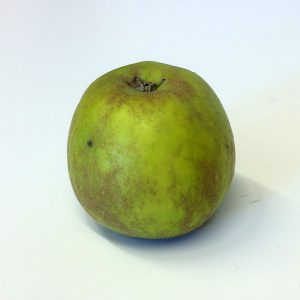
Ribston Pippin. Image: Wikipedia.
A Ribston Pippin is a sharp- tasting dessert apple, originally grown at Ribston Hall, near Knaresborough, from a pip brought over from Rouen in France and planted in the grounds of Ribston Hall in the late 17th century century.
It can be called by other names, including ‘Glory of York’, Essex Pippin, and ‘Rockhill’s Russet’, often linked to a particular orchard or fruit grower.
It is an apple that keeps well and develops its flavour in storage. It is related to the better-known Cox’s Pippin, but some argue that that Ribston has the better flavour!
Hunt House
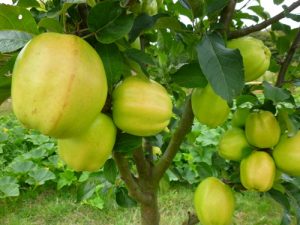
Hunt House Apples. Image: Wortley Hall Walled Garden
Hunt House apples also have their Yorkshire roots in the early 18th century, and are named after the orchard at Hunthouse in Goathland, near Whitby, where they were grown. They are a good cooking variety that bake particularly well.
The story goes that Captain Cook, who hailed from Whitby, took a supply of these apples with him on his sea journeys to ward off scurvey among the crew.
Hornsea Herring
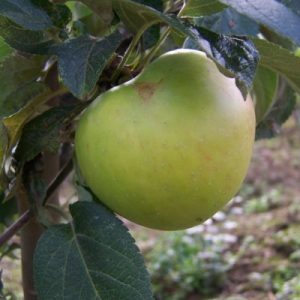
Hornsea Herring. Image: R.V. Roger Nurseryman.
The Hornsea Herring cooking apple has its regional origins in the late 18th century. It is now an uncommon variety, although it is a produces attractive large fruit for cooking that makes a good puree with a flavour of acid drops.
Yorkshire Cockpit

Yorkshire Cockpit apple. Image: Keeper’s Nursery
The origins of Yorkshire Cockpit apples can be traced back to the early part of the 19th century and was a popular apple to grow in Yorkshire throughout that century.
It is a cooking apple with a sharp taste and soft juicy fruit. It reduces quickly in cooking to a puree.
Fillingham Pippin
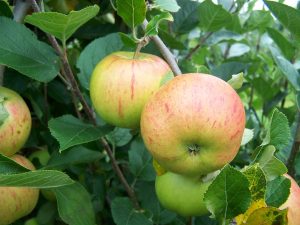
Fillingham Pippin. Image: Habitat Aid
Another Yorkshire apple with its origins in the early 19th century is the Fillingham Pippin.
It comes from the Swanland area of East Yorkshire, near Hull, and was said to have been raised from a pip from an American tree. It is an eating apple with a fruity/acid taste.
Flower of the Town

Flower of the Town. Image: Habitat Aid.
Flower of the Town can also be traced back to the early 19th century, and is now quite uncommon in the region and elsewhere. It is an attractive bright red eating apple, sharply sweet in taste.
Green Balsam
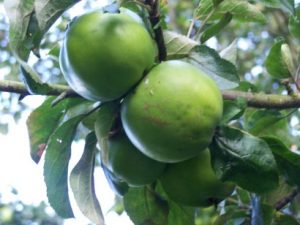
Green Balsam. Image: Heritage Aid.
The Green Balsam is a small, bright green cooking apple, once very commonly grown across the region, particularly in North Yorkshire.
It was often referred to as the ‘Farmer’s Wife’s Apple’ because most ended up on the table in desserts, rather than for cider making.
The fruit is acidic, but not particularly juicy, and the blossom is an attractive pinkish/white.
Dog’s Snout

Dog’s Snout. Image: Heritage Aid
Dog’s Snout – because of its distinctive shape. The flesh is soft, but the skin turns greasy with cooking, so this once popular apple in Yorkshire during the 19th century gradually fell from grace in favour of other cooking varieties and can now be difficult to find.
Grandpa Buxton
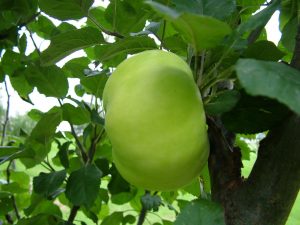
Grandpa Buxton. Image: Fruitscape.
A 20th century additions is the Grandpa Buxton, originating from Copt Hewick, near Ripon, and dating from the mid 1990’s. It has proven to be a popular early cooking apple, distinguished by its attractive yellow/green fruits, and good cooking qualities.
*
Sources of Yorkshire Apples
To find orchards and orchard produce in Yorkshire go to the England in Particular website at Yorkshire Orchards
*
Reference:
Morris, G.E. (1986) ‘Old Apples of Yorkshire’ in Dalesman, May 1986, pp.134-5.


