

Joan Poulson, in her book, Yorkshire Cookery (1979) describes the Yorkshire tradition of high teas, usually served between five and six pm. From the late 19th century to mid 20th century, this was a convenient time, fitting in midweek with workers arriving home and children back from school, and on Sundays fitting in with washing-up time to be done before evening chapel or church service.
Sunday high tea also overtly demonstrated, to the wider family members invited, the cooking skills of the host and the prosperity of the family.
It is unthinkable to serve high tea in ‘dribs and drabs’ as it would be to serve packeted Yorkshire Pudding. Everything is placed upon the table at the start of the meal and as much as possible is home-made, from the bread to the pickles (p.20).
Joan describes how tinned salmon, from the early 20th century onward, became a staple part of the tea, although home-made pies of all types were more popular with the men. There was also an emphasis on boiled ham, which became a symbol of respectability toward the end of the 19th century, when a respectable funeral was synonymous with ham served afterwards at the funeral tea.
The great distinction between a typical high tea and a funeral tea was that in some families it was considered ‘fast’ or ‘flighty’ to serve anything sweet at a funeral tea. Boiled ham, pickles and home-made bread or tea cakes were respectable. Spice-cake, curd tarts, tipsy cake and parkin were not (p.21).
However, one type of biscuit acceptable at funerals was – the funeral biscuit. This was either baked at home or ordered from a baker who advertised ‘funeral bread and biscuits’.
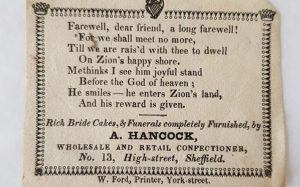
Advertisement for ‘Rich Bride Cakes & Funerals…’ Image: Bradford Museums & Galleries.
The biscuits were given to mourners to take home, sometimes wrapped in white paper with black sealing wax (see example below), and often bearing the name of the deceased along with a suitable poem or biblical verse or quotation.

Image: Lou Morgan
Many of them describe the biscuits or biskeys as being like plain Yorkshire tea-cake. Others remember that they were slightly sweetened, contained caraway seeds and were called ‘funeral cakes’. Some families owned engraved wooden stamps which were only used to impress patterns on funeral biscuits. They were handed down through the generations and were greatly prized (p.21).
A typical funeral tea in the early 19th century onwards in a fairly prosperous family, particularly in the more rural areas, would include oatcakes, cheese, ham, and bread. A funeral tea, was not only a sign of respect to the deceased, it was also appreciated by mourners who had travelled long distances, and who would usually take surplus food back with them to share with other family members. The funeral tea would also act as a symbol of the surviving family member’s continuing respectability.
Perhaps the origin of the use of boiled ham as a traditional part of the Yorkshire funeral or high teas lies in the fact that ham was available to anyone having land on which to keep a pig. Anyone without pig-keeping facilities was poor indeed during the industrialized nineteenth century (p.22).
Source: Poulson, J. (1979) Yorkshire Cookery. Published by B.T. Batsford.


