

Introduced in the early years of the 19th century, the bakestone became an important cooking feature of many Yorkshire farmhouse kitchens, and particularly in the western Pennine Dales. They were the equivalent of the flat hotplate on a modern cooker.
Although cooking on bakestones had been practised for hundreds of years, they became increasingly a built-in feature of farmhouses in the Dales and elsewhere in Yorkshire. This was largely because they were an effective way of cooking large batches of oatcakes from oatmeal – a staple part of diet in the Dales, where oats would at least survive an often wet and cold climate and a high altitude.
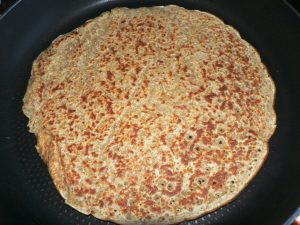
Oatcake
Oatmeal, ground at a local corn mill, became an essential part of the diet, eaten as porridge or oatcakes, and particularly the latter.
Marie Hartley and Joan Ingleby, writing for the Dalesman in 1988, noted that:
Oatcake may seemed to have been a monotonous diet lacking in variety, but families relished it and it was suited to the active lives of the people of those days. Even when speaking of it in the 1960s, faces lit up with pleasurable recollections. Besides being eaten warm from the bakestone with butter or treacle, it was mostly eaten when dried crumbled up in broth or with butter and cheese at any meal. A farmer might take a pocketful when shepherding on the fell, and always quantities were baked in readiness for lambing time, haytime and in the old days salving time (p.641).
Bakestones were thin slabs of locally available and treated stone able to withstand direct heat. They were hewn smooth on one side and grooved on the other. The grooved side straddled a brick or stone-built firebox, fuelled by anything that could be burnt: wood, ling, bracken, and occasionally coal. The baking stones were often large, sometimes around 4 feet wide by 2 feet in depth.
Stone is in abundance in the Yorkshire Dales, so it became the obvious material to use. The bakestone and its firebox were usually built immediately adjacent to the central fireplace and cooking range so that the fumes and smoke from the firebox were drawn by a connecting flue up the central chimney.
The cooking surface of the stone had to be treated before use to stop the oatcakes from sticking; one bakestone maker rubbed into the stone a mixture of brown sugar and suet (Brears, 2014, p.109), and cooks might rub bacon fat into the stone before or after each use.
A farm with a bakestone would typically invite other local farming families on scheduled baking days to bring their own oatmeal mixtures to cook so that large batches could be made at one time. The finished oatcakes would be hung on a rack (also called a creel or flake) above the fire to dry and to store for short-term future use.
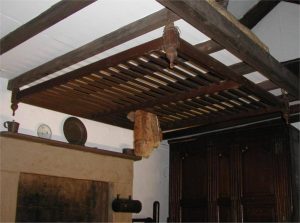
Oatcake drying rack. Image: Bushcraft UK
The oatcake ingredients were typically buttermilk or ‘blue milk’, warm water, fine oatmeal, salt, and yeast or (later)bicarbonate of soda. The mixture would be stirred by hand in a tub to a thick pouring consistency. Marie Hartley and Joan Ingleby (1988) observed a traditional oatcake cooking process in one farmhouse:
A ladelful of this was put onto a riddleboard already sprinkled with oatmeal and the whole rotated by hand to spread the mixture, which was then transferred to a piece of linen or paper on the spittle and thrown with a jerk from the spittle on to the bakestone; the linen was removed and the typical oval shape formed. It was turned once with the spittle and then hung to dry on the flake… (Hartley and Ingleby, 1988, p.639)
However, easier ways of making oatcakes on a bakestone gradually evolved, becoming more the norm, which involved just pouring a measured quantity of batter onto the stone and spreading to the size and shape required with a wooden scraper.
Sources:
Brears, P. (2014) Traditional Food in Yorkshire. Prospect Books.
Hartley, M. and Ingleby, J. (1988) ‘The Farmhouse Bakestone’ in Dalesman, Nov.no.8, pp.638-641.
Also see the recipe for oatcakes and the article The Oatcake Maker of Skipton.


2 Responses to The Farmhouse Bakestone
Good Sunday, from the snowy, rural, Northern part of New York State, USA.
Have chanced upon this wonderful site thanks to a story in the latest missive from Genealogy Jude’s website.
Please allow me to join the list of people who receive emails and notices from you.
Thank you
Good to have you on board, Janine. And our fraternal greetings to you too from God’s Own here in England. I’m too damn lazy to send out emails & notices though! Just keep checking in on the site and enjoy the lovely-grub recipes and articles I add from time to time.