


In his autobiography, ‘A Country Lad Looks Back’, Peter Wolfenden remembered growing up on his family farm on the Yorkshire/Lancashire border in the 1930s and 40s. The kitchen and pantry of the farmhouse was the hub of the home. He writes:
‘ The kitchen, I remember, was of a reasonable size. It had to be, to seat our large family for every meal. There was no such thing as carpets or oilcloths on the floor; it was just bare sandstone flags. Only in front of the kitchen fire was a large pegged rug that my Grandmother had taken pride in making, from worn out overcoats and clothing, with cattle feed sacks for lining. The kitchen floor was always scrubbed, swilled, and mopped clean everyday by my mother.’
‘The fireplace was, I believe, an original from when the house was built. This was a huge cast iron one with side oven, where my mother did all the baking. With eleven mouths to feed it was rather like a production line for bread, cakes and buns.’
‘The oven was on the right hand side of the fireplace and the side boiler on the left. The side boiler would hold about twelve gallons of water, which wasn’t a lot when washing and bath nights took place. The side boiler was also cast iron and therefore the water always had a rusty appearance. In the centre of the chimney was a large hook where the kettle was permanently hung ready for unexpected brews that were frequently needed. There were yet more fixtures on the fireplace, one was a heavy, gate type bar, which hinged down to be used as a support for the many pans when dinner was being cooked. Often the potatoes and vegetables tasted of smoke when cooked on the open fire. My mother took particular pride cleaning the fireplace; all the chrome parts were polished and the rest black-leaded weekly. The chrome parts were polished with Shineo, until you could see your face in it.’
‘The centrepiece in the kitchen was the huge wood table that had to seat ten at most meals: seven children, my father and two farm men. My mother seldom sat down at mealtimes with the family, as she was occupied sorting out and serving food. There was no tablecloth, just a type of light oilcloth that was wiped down with the tablecloth after every meal.’
‘In the early 1940s there were no refrigerators, so storing fresh meat and fish was literally impossible. Therefore, once you had purchased fresh food or grown it in your kitchen garden, you had to eat it as soon as possible, which wasn’t too difficult in our household.’
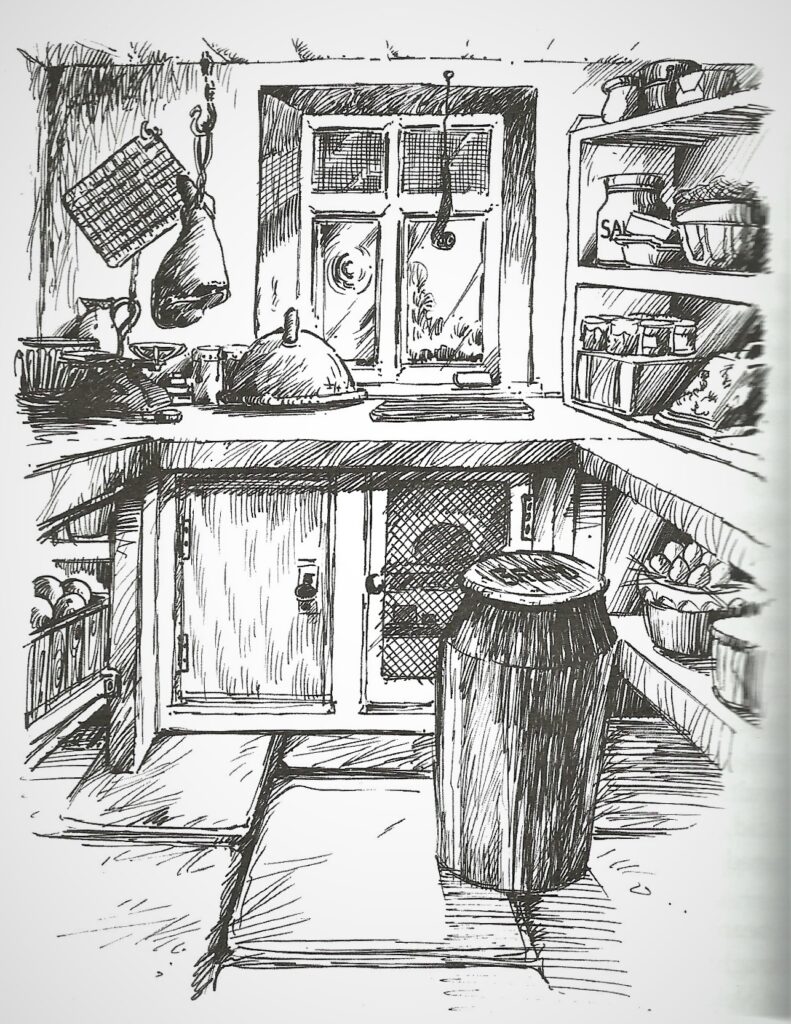
‘During the season, stocks in the farmhouse pantry varied from enough for a week to enough for a month, so a large pantry was required. On our farm there were two pantries, one was the near pantry and the other was the far pantry. The near pantry was for everyday food, such as milk and eggs that we produced on the farm, also for salt, fat, lard, currants, raisins, oatmeal, flour etc. In the first pantry there were two large slab sandstone flags on adjacent walls. These flags were around six feet long by four feet wide and a good three inches thick. These large stone slabs were used as storage benches, well out of the way of vermin, rats and mice etc. There would be stone jars and pots containing a varied selection of potted pork, lard that was used for pies and pastry, also fat for the chip pan. There was always a 3-gallon bucket of milk on the slab ready for a multitude of different uses.’
‘There were also large tins of rice, semolina, sago, tapioca and stocks of macaroni ready to make the large pans full of puddings required to feed the many young mouths. There would be a bucketful of new laid eggs, maybe three or four dozen, also a large earthenware tub where cream was stored to make the many pounds of butter the family used every week. On a corner there was a large wooden meat-safe, which in simple terms, was a wooden cupboard clad in perforated zinc. This was where we kept fresh and cooked meat to protect it from flies and bluebottles.’
‘Also on the sandstone slab was a stone jar containing crushed salt, which was purchased in large fourteen-pound blocks. Crushing the salt was one of my many unpaid jobs. What I had to do was slice the salt from the slab, then crush it with my mother’s large wooden rolling pin.’
‘There was also a large pine cupboard in the first pantry. This was used to store baking tins, large meat plates, potted meats, bottled fruit and many varieties of home preserved jam … There was an abundance of various hooks and nails that all had a use and from which hung dried herbs, mint, strings of shallots and onions – also the filed bills and receipts for many years’ accounts on the farm, all gathering dust on the unique filing system.’
Source: Peter Wolfenden (2001) A Country Lad Looks Back. Published by Hill Carr Books.


