

Writer and local historian, Robin Longbottom, writes here about the demise of havercakes (or oatcakes) from the Yorkshire scene:
If we were told that chips would vanish from our dinner tables within a generation, we would find it impossible to believe – and yet this is just what happened to the havercake.
Havercake, also known as oatcake, was a traditional flatbread and once the staple food in the Pennines.
It was made from oats or haver, from hafre old Norse for oats, which was the only cereal that grew well on the poor soils of the Pennine uplands.
Havercakes were made from fine oatmeal. It was mixed with water, or blue milk (skimmed milk), to make a batter and left to ‘sour’ overnight. The following morning the batter was ladled onto a wooden board dusted with oatmeal and either ‘thrown’ directly onto a hot bakestone (griddle) or transferred onto a second board covered by a piece of linen and then flipped over onto the bakestone. When cooked on one side it was turned over with a long knife.
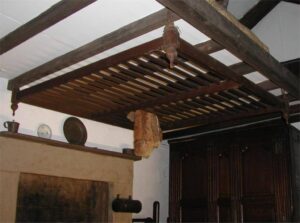
The process produced a floppy, elongated, flat bread that was then hung over the slats or strings of a bread creel suspended from the ceiling and left to dry (see photo below). Once dry it became crisp and could be stored for months.
Most homes had a bakestone in the early 19th century (see line drawing below) but if a farmer’s wife did not have time to make her own havercake she often employed someone to do it. Women would travel from farm to farm spending all day making large batches, one old lady recalling that she thought she had made enough in her lifetime to cover 500 acres.

Havercakes were eaten both soft and hard. Whilst soft they were spread with butter, treacle or honey and rolled up to be eaten. They could be toasted and spread with butter. Hard havercakes were eaten with cheese or softened in a bowl of milk. Havercake sop was a family favourite, the cake dipped into the dripping pan from the Sunday roast. Inns kept a ready supply and customers broke them up and dunked them in beer. On the Craven/Lancashire border pubs served stew and hard until about 20 years ago. A crisp havercake was broken in half to sandwich a slab of stew (a potted meat made from shin beef and cow heel jelly) and sliced onion.
Commercial havercake bakers set-up businesses in many towns and villages. Housewives gradually gave-up baking their own and came to rely on buying them. By the early 1900s havercake men, or oatcake men, were a familiar sight hawking them around South Craven and the Dales. In the 1930s John Denny of Skipton recalled how he had travelled the district by ‘Shank’s Pony’ carrying 60 to 70lbs in a basket on his back. On Mondays he walked over Embsay and Barden moors to Burnsall and his arrival time was so regular that the villagers were said to have set their clocks by him.
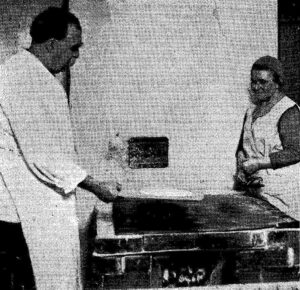
John Leach, commercial oatcake maker, Skipton, 1942. Photo: Dalesman.
The Keighley area had several oatcake bakers – Nicholas Ogden at Morton Banks, Harry Law at Damems and Albert Feather, who came from Hebden Bridge and opened a bakery in Haworth in 1921. When Albert retired his son Leslie took over the business and was a familiar sight carrying his basket of havercakes and muffins along the lanes of Haworth until 1968 when the business finally closed.
*
Source: Longbottom, R. Keighley News, ‘Memory Lane’, Thursday 10 March 2022,
You can find a recipe for oatcakes (havercakes) here Oatcake Recipe


4 Responses to What’s Happened to Havercakes?
Thanks for this fascinating history. You can see a hanging oatcake rack above the fireplace in photos of the Green Dragon in Hardraw. However, the pub is currently for sale, and in more recent online photos the rack appears to have been removed.
Here is another huge one for sale, dating from approximately 1870: https://www.sellingantiques.co.uk/364913/very-large-antique-yorkshire-oat-cake-rack/
These must be quite rare now.
I was taught to make them around 1960 by a farmers wife, Mrs James, of Pateley Bridge, who also taught me to make cheese and butter and took me with her to sell butter and eggs in Ripon market. She also took a few oatcakes with her for favoured customers. She threw them from a cloth but I have never managed to get the technique right and instead spread my batter with a palate knife – cheating I know. I use the recipe from Dorothy Hartley’s Food in England:she got it from the last oatcake maker in Skipton
The North Staffordshire or “Potteries” Oatcake still going strong in North Staffordshire
Delicious with bacon and cheese.
We still have oatcakes in staffs. Great with cheese and bacon for breakfast.